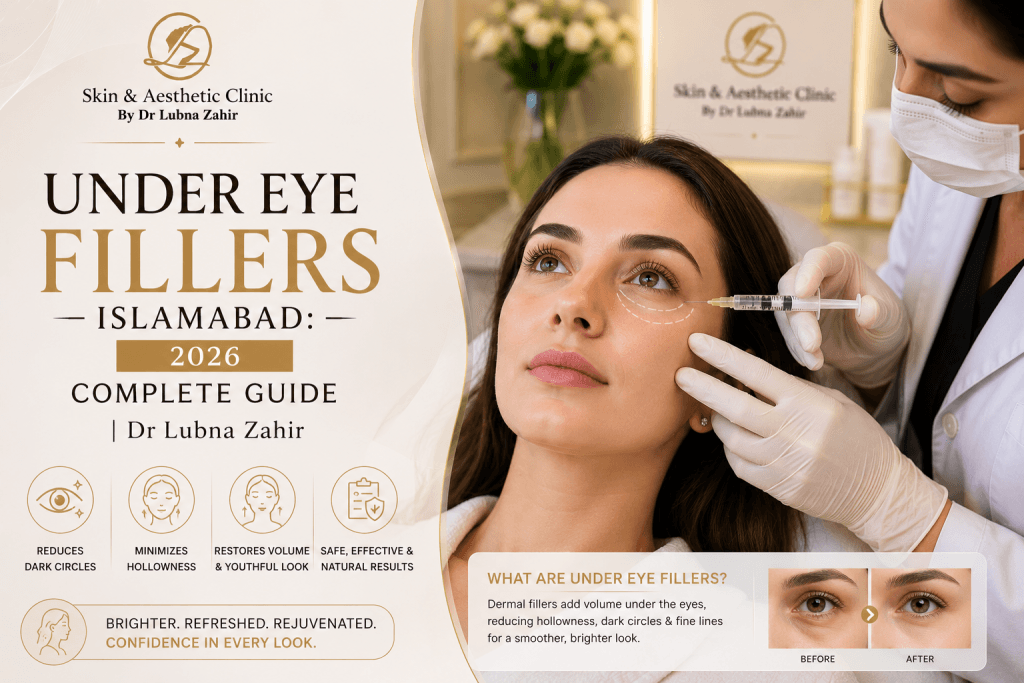
Under Eye Fillers Islamabad: 2026 Complete Guide | Dr Lubna Zahir
Persistent dark circles, sunken sockets, and tired-looking eyes can make you appear exhausted despite getting adequate rest. Consequently, seeking professional under eye fillers islamabad has become one of the most requested aesthetic procedures across the capital. Whether you commute to our clinic from nearby sectors like E-11, F-11, and G-11 or travel from DHA and Bahria Town, your periorbital area requires delicate anatomical expertise.
At Dr. Lubna Zahir Aesthetic Clinic & Salon in F-10/4 Markaz, we prioritize safety, natural facial balance, and medical precision. Our clinic utilizes advanced, micro-cannula techniques and premium hyaluronic acid formulations. Therefore, you can restore youthful under-eye contours, eliminate harsh shadows, and brighten your overall expression without invasive surgery.
The Anatomy of Periorbital Aging and Tear Trough Deformity
To understand how injectable rejuvenation works, we must examine the complex anatomical architecture surrounding the human eye. The periorbital skin is the thinnest on the human body, measuring roughly 0.5 millimeters in thickness. Furthermore, this delicate area contains minimal subcutaneous fat cushions and sebaceous glands.
+-------------------------------------------------------------------+
|               ANATOMY OF UNDER-EYE VOLUME LOSS                    |
+-------------------------------------------------------------------+
| 1. Orbital Bone Resorption    --> Widening of the eye socket      |
| 2. Fat Pad Descent & Atrophy  --> Formation of the sub-orb groove |
| 3. Skin Thinning & Laxity     --> Visible underlying vasculature   |
| 4. Tear Trough Ligament Pull  --> Deep tethered shadow formation   |
+-------------------------------------------------------------------+
Over time, multiple physiological changes contribute to a tired, hollow under-eye appearance:
-
Orbital Bone Resorption: As we age, the underlying orbital rim gradually widens and recedes backward.
-
Sub-Orbicularis Oculi Fat (SOOF) Descent: The deep fat pads supporting the lower eyelid thin out and shift downward.
-
Tear Trough Ligament Tethering: A true anatomical ligament anchors the skin firmly to the underlying bone, creating a distinct depression.
-
Vascular Shadowing: Thinning translucent skin allows dark, deoxygenated blood within deep venous networks to show through clearly.
Consequently, a physical shadow forms along the lower eyelid margin. Traditional cosmetic eye creams cannot restore deep bone support or replace depleted fat volumes. Therefore, precise placement of under eye fillers islamabad physically elevates this sunken groove. As a result, the light reflects evenly across the lower eyelid, eliminating shadow-based dark circles immediately. You can explore broader clinical discussions on periorbital aging on Healthwire’s verified dermatology platform.
How Hyaluronic Acid Restores Under-Eye Volume
Hyaluronic acid (HA) represents the gold standard substance for non-surgical under-eye correction. Hyaluronic acid is a naturally occurring sugar molecule found within your own extracellular tissue matrix. In fact, a single molecule of hyaluronic acid can bind up to 1,000 times its weight in water.
However, the periorbital zone requires specialized, low-hydrophilic dermal filler formulations. If a clinician injects standard, high-volumizing cheek fillers beneath the eyes, the product absorbs excessive water. Consequently, the patient experiences chronic morning puffiness and unnatural swelling.
At Dr. Lubna Zahir’s clinic, we select lightweight, cohesive HA gels like Teosyal Redensity II and Restylane Eyelight. These specialized gels possess unique rheological properties:
-
Low Hygroscopic Behavior: The gel does not absorb excessive fluid after injection, preventing post-treatment water retention.
-
Smooth Tissue Integration: The soft gel spreads evenly along the pre-periosteal plane, preventing noticeable lumps.
-
Essential Micronutrient Blends: Certain premium fillers contain amino acids, antioxidants, and zinc to brighten the skin barrier concurrently.
Furthermore, hyaluronic acid is entirely reversible. If an adjustment is ever necessary, our clinical team can administer a specialized dissolving enzyme called hyaluronidase. Therefore, HA injectables offer unmatched safety and clinical control.
Diagnostic Classification: Grading Under-Eye Hollows vs. Pigmentation
Achieving an exceptional aesthetic result requires distinguishing between structural volume loss and true skin hyperpigmentation. Many patients mistakenly assume all dark circles require fillers.
The Hirmand and Barton anatomical classification systems help categorize periorbital concerns systematically:
| Classification Grade | Anatomical Characteristics | Root Physiological Cause | Recommended Clinical Protocol |
| Class I: Mild Medial Hollow | A shallow depression confined strictly to the inner tear trough zone | Early localized fat pad thinning & genetic ligament tethering | Conservative micro-cannula Tear Trough Filler (0.5 ml per side) |
| Class II: Moderate Full Hollow | The depression extends across both medial and lateral orbital borders | Progressive mid-face fat loss and orbital rim bone resorption | Full tear trough filler combined with deep cheek structural support |
| Class III: Severe Circumferential Deficit | Deep hollow extending from inner eye to cheekbone with visible margin | Advanced multi-layer tissue deflation and loss of skin elasticity | Combination therapy: Deep structural Dermal Fillers + skin tightening |
| True Hyperpigmentation (Pigmentary) | Brownish discoloration without any physical groove or structural shadow | Excess melanin synthesis triggered by genetics, friction, or UV rays | Targeted Q-Switch Laser toning and medical Chemical Peels |
| Vascular Translucency (Vascular) | Bluish-purple tint visible beneath ultra-thin, crepey lower eyelid skin | Poor microcirculation and visible underlying orbicularis muscle | Regenerative PRP Treatment or Polynucleotide (PDRN) therapy |
Clinical Comparison: Fillers vs. Alternative Periorbital Treatments
Selecting the appropriate treatment modality depends entirely on your specific anatomical indications. Review the comparative matrix below to evaluate how tear trough fillers compare to other popular aesthetic procedures:
| Clinical Modality | Primary Target Deficit | Immediate Correction | Duration of Results | Recommended Frequency |
| Hyaluronic Acid Under-Eye Fillers | Deep structural hollows and shadow lines | 100% Instant Volume | 9 to 18 Months | Annual maintenance touch-up |
| Platelet-Rich Plasma (PRP Therapy) | Skin thinning, dark tint, and fine crepey lines | Gradual biological repair | 6 to 12 Months | Series of 3 sessions spaced 4 weeks apart |
| Polynucleotides (Salmon DNA / PDRN) | Cellular damage, inflammation, and skin laxity | Progressive tissue thickening | 6 to 9 Months | Series of 3 sessions spaced 3 weeks apart |
| Fractional CO2 Laser Resurfacing | Severe superficial wrinkling and loose eyelid skin | Visible skin contraction | 2 to 3 Years | 1 to 2 sessions with 7 days social downtime |
| Surgical Lower Blepharoplasty | Severe herniated fat bags and excess redundant skin | Permanent fat transposition | 7 to 10+ Years | Single invasive surgical procedure |
For verified patient reviews and clinical insights across Pakistan, explore Marham’s aesthetic directory.
Advanced Injection Techniques: Blunt Micro-Cannula vs. Sharp Needle
The technical method used to deliver dermal fillers around the eyes dictates both safety and outcome quality. Historically, practitioners used sharp hypodermic needles for under-eye injections. However, sharp needles carry a higher risk of puncturing delicate blood vessels, leading to bruising and vascular complications.
At Dr. Lubna Zahir Aesthetic Clinic & Salon, we utilize the advanced Blunt Micro-Cannula Technique:
+-------------------------------------------------------------------+
|               BLUNT CANNULA VS. SHARP NEEDLE INJECTION            |
+-------------------------------------------------------------------+
| [Sharp Needle]: Cuts through tissues --> Higher risk of bruising  |
| [Blunt Cannula]: Glides around vessels --> Minimizes tissue trauma |
+-------------------------------------------------------------------+
Why the Micro-Cannula Technique is Superior:
-
Single Entry Point: We create one tiny entry point on the upper cheek using a fine needle. Subsequently, the flexible cannula enters through this single opening to treat the entire under-eye area.
-
Vascular Safety: The rounded, blunt tip pushes delicate blood vessels aside rather than cutting them. Consequently, the risk of bruising, hematoma, and intra-arterial injection is drastically reduced.
-
Smooth, Layered Placement: The cannula allows our specialist to lay down micro-threads of filler deep along the periosteal bone plane. This deep placement prevents the product from sitting too close to the surface.
-
Minimizing the Tyndall Effect: Placing filler too superficially can cause light to scatter through the skin, creating a bluish discoloration known as the Tyndall effect. Deep pre-periosteal cannula placement completely eliminates this aesthetic risk.
Candidate Selection and Essential Safety Exclusions
Achieving beautiful, natural-looking results requires selecting the right candidates. Not every individual with under-eye darkness is a suitable candidate for dermal injectables.
+-------------------------------------------------------------------+
|                  CANDIDACY QUALIFICATION CHECKLIST                |
+-------------------------------------------------------------------+
| [✓] Visible structural hollows along the tear trough margin       |
| [✓] Good lower eyelid skin elasticity without severe laxity       |
| [✓] Realistic expectations regarding subtle, refreshed results    |
| [✓] Absence of prominent herniated pseudo-fat bags                |
| [X] Severe fluid-filled malar festoons or chronic eye edema       |
| [X] Excessive skin redundancy requiring surgical excision         |
| [X] Active sinus infections, dental infections, or skin lesions   |
| [X] Pregnancy, active breastfeeding, or autoimmune disorders      |
+-------------------------------------------------------------------+
Who Benefits Most:
-
Genetically Hollow Eyes: Younger patients who have deep tear trough depressions regardless of sleep or lifestyle.
-
Age-Related Volume Loss: Professionals in their 30s to 50s noticing progressive hollowing beneath the eyes.
-
Post-Weight Loss Clients: Individuals whose facial fat reduction has left the orbital rims hollow and exposed.
Who Should Avoid Under-Eye Fillers:
-
Large Herniated Fat Bags: If orbital fat pads protrude heavily, adding filler will only make the eye bags look larger. These patients require surgical lower blepharoplasty.
-
Malar Festoons & Poor Lymphatic Drainage: Patients with chronic fluid retention or festoons over the cheekbones will experience worsening swelling after filler placement.
-
Severe Skin Laxity: When the skin lacks structural elasticity, injectable gels cannot provide adequate tension. These individuals benefit more from skin-tightening modalities like Microneedling or HIFU Treatment.
For additional candidacy guidelines in Pakistan, review Oladoc’s verified clinical repository.
Step-by-Step Clinical Experience at Dr. Lubna Zahir’s Clinic
We maintain rigid sterile protocols to ensure your treatment experience is safe, smooth, and relaxing. Here is what you can expect during your appointment at our F-10 Markaz facility:
+-------------------+      +-------------------+      +-------------------+      +-------------------+
| STEP 1:           |      | STEP 2:           |      | STEP 3:           |      | STEP 4:           |
| Vector Mapping &  | ---> | Antiseptic Prep & | ---> | Precision Cannula | ---> | Gentle Molding &  |
| Diagnostic Check  |      | Local Anesthesia  |      | Deep Placement    |      | Aftercare Brief   |
+-------------------+      +-------------------+      +-------------------+      +-------------------+
Step 1: Vector Mapping and Pre-Treatment Assessment
First, Dr. Lubna Zahir evaluates your eye area under optimal clinical lighting. We examine the depth of the tear trough, check orbital fat positioning, and map out the exact micro-entry points on your cheeks.
Step 2: Cleansing and Local Anesthetic Preparation
Next, our clinical team thoroughly cleanses the skin with medical antiseptic solutions. We apply a high-potency topical numbing cream to the cheek entry point for 20 minutes. In addition, the premium hyaluronic acid fillers we use contain integrated lidocaine, which numbs the deep tissues instantly during delivery.
Step 3: Precision Micro-Cannula Delivery
Subsequently, our physician creates a tiny entry point on the mid-cheek. The blunt micro-cannula enters smoothly, gliding beneath the muscle to reach the tear trough ligament. We deposit tiny micro-droplets of gel deep along the bone, gently filling the hollow space without over-correcting.
Step 4: Gentle Molding and Cold Compression
Finally, we gently mold the product to ensure a perfectly seamless transition between your lower eyelid and cheek. We apply a soothing cold compress for two minutes to prevent swelling. The entire injection phase takes roughly 15 to 20 minutes.
Recovery Protocol and Result Timeline
Because we utilize the gentle micro-cannula technique, social downtime remains remarkably minimal. However, following our medical aftercare guidelines ensures that the filler integrates smoothly into your tissue matrix.
| Timeframe | Biological Tissue Integration | Visible Physical Appearance | Patient Care Guidelines |
| Hours 0 – 12 | Hyaluronic gel settles along the pre-periosteal plane | Immediate reduction of hollows; minor needle pinprick on cheek | Avoid touching the area; do not apply eye makeup |
| Days 1 – 3 | Minor localized fluid equilibrium; tissue adapts to gel | Slight, temporary morning puffiness or mild tenderness | Sleep on your back with head elevated; avoid intense exercise |
| Days 4 – 7 | Gel integrates seamlessly with surrounding dermal tissue | Swelling resolves completely; smooth under-eye contours appear | Avoid saunas, steam rooms, and hot showers; apply gentle moisturizers |
| Week 2 | Full hydrophilic stabilization and tissue integration | Optimal, natural, and brightened periorbital appearance | Attend scheduled 2-week follow-up assessment at our clinic |
| Months 9 – 18 | Slow, natural biological breakdown via endogenous enzymes | Sustained volume correction and shadow elimination | Plan annual maintenance consultation with Dr. Lubna |
Essential Post-Treatment Care: What to Do and Avoid
Strict adherence to clinical aftercare protects your investment and ensures smooth, long-lasting results:
What to Do:
-
Elevate Your Head: Sleep with an extra pillow for the first two nights to minimize fluid accumulation.
-
Apply Cold Compresses: Use a clean, wrapped ice pack for five minutes at a time if you notice mild swelling.
-
Stay Hydrated: Drink plenty of water to help the hyaluronic acid integrate naturally into your tissues.
-
Protect from Sunlight: Apply a broad-spectrum mineral SPF 50+ to protect your skin from intense Margalla UV rays.
What to Avoid:
-
No Rubbing or Massaging: Do not press, rub, or massage the under-eye area for at least two weeks.
-
Avoid Heavy Workouts: Refrain from strenuous gym workouts, heavy lifting, or inverted yoga poses for 48 hours.
-
Pause Facial Treatments: Do not schedule facial massages, chemical peels, or laser treatments for two weeks.
-
Avoid Blood Thinners: Skip aspirin, vitamin E supplements, and green tea for 48 hours to minimize any bruising risk.
Combining Under-Eye Fillers with Complementary Clinical Modalities
For patients seeking complete facial harmony, combining tear trough rejuvenation with complementary treatments yields remarkable results:
+-------------------------------------------------------------------+
|                  COMPREHENSIVE PERIORBITAL COMBINATIONS           |
+-------------------------------------------------------------------+
| 1. Fillers + Cheek Volumization  --> Restores foundational mid-face |
| 2. Fillers + Botox Crow's Feet   --> Smooths active dynamic lines   |
| 3. Fillers + PRP / PDRN Therapy  --> Thickens thin, dark skin matrix |
| 4. Fillers + Medical HydraFacial --> Deep hydration & skin polish  |
+-------------------------------------------------------------------+
1. Mid-Face Cheek Support + Tear Trough Correction
In many patients, under-eye hollowing occurs because the cheek fat pads beneath have deflated. Therefore, placing deep Dermal Fillers in the mid-cheek first restores foundational support. Consequently, we often need less filler directly in the tear trough, achieving a more natural transition.
2. Botox for Crow’s Feet
While fillers correct static hollows, repetitive smiling creates dynamic wrinkles around the outer eyes. Combining your filler with Botox Treatment gently relaxes the lateral orbicularis muscle, smoothing crow’s feet while keeping your expressions natural.
3. Autologous PRP or Polynucleotide Skin Boosters
If you suffer from both deep hollows and dark, thin skin, a hybrid approach works best. We use hyaluronic acid to physically lift the hollow, followed by PRP Treatment or Mesotherapy to stimulate collagen and thicken the translucent skin barrier.
4. HydraFacial Periorbital Polish
Before receiving injectables, preparing the skin with an authentic [HydraFacial] purges congested pores and infuses antioxidants, providing an ideal, glowing canvas.
Why Choose Dr. Lubna Zahir Aesthetic Clinic in F-10 Markaz?
The under-eye area contains intricate vascular networks and delicate nerves. Therefore, choosing a qualified medical specialist is critical to avoid complications like product migration, lumping, or vascular occlusion.
At Dr. Lubna Zahir Aesthetic Clinic & Salon, we guarantee unmatched clinical standards:
-
Expert Medical Supervision: All treatments are performed by experienced aesthetic physicians with advanced periorbital training.
-
100% Authentic, Premium Injectables: We use only FDA-approved, factory-sealed products from globally recognized manufacturers.
-
Safety-First Cannula Protocols: We employ blunt micro-cannula techniques to protect your vascular integrity and prevent bruising.
-
Conservative Aesthetic Approach: We believe in subtle, elegant enhancement, ensuring you never look puffy, overfilled, or unnatural.
-
Convenient Location: Situated at Sarran Plaza, Sagheer Market, F-10/4 Markaz, our clinic offers discreet, luxurious care for clients across Islamabad and Rawalpindi.
Reclaim Your Refreshed, Youthful Look Today
Stop letting tired, shadowed eyes conceal your natural vitality. Experience the confidence-boosting benefits of professional under eye fillers islamabad customized by medical specialists.
Restore smooth, luminous under-eye contours and look remarkably refreshed every day. Click Here to Message Us Directly on WhatsApp at 03330300223 or visit our clinic at Sarran Plaza, Sagheer Market, F-10/4 Markaz, Islamabad to book your personal periorbital evaluation today.
FAQ’s:
How much do under eye fillers cost in Islamabad?
At Dr. Lubna Zahir’s F-10 clinic, premium tear trough filler treatments typically range from PKR 35,000 to PKR 45,000 per syringe. The total price depends on the specific brand of hyaluronic acid gel utilized and whether supplementary mid-cheek support is required.
Are under eye filler injections painful?
No, the procedure is very comfortable. We apply a high-strength topical numbing cream to the cheek entry point before treatment. Furthermore, our premium fillers contain integrated lidocaine, and our blunt micro-cannula glides smoothly beneath the skin without sharp cutting.
How long do under eye fillers last?
Because the under-eye area experiences minimal muscle movement compared to the lips, hyaluronic acid breaks down slowly. Most patients enjoy smooth, brightened under-eye contours for 9 to 18 months before scheduling a maintenance session.
Can under eye fillers fix all dark circles?
Fillers specifically correct dark circles caused by structural hollows and shadowing. However, if your dark circles stem from surface skin pigmentation or genetics, our team will recommend complementary treatments like Q-Switch Laser toning, Chemical Peels, or PRP Treatment.